Posts tagged Immigration
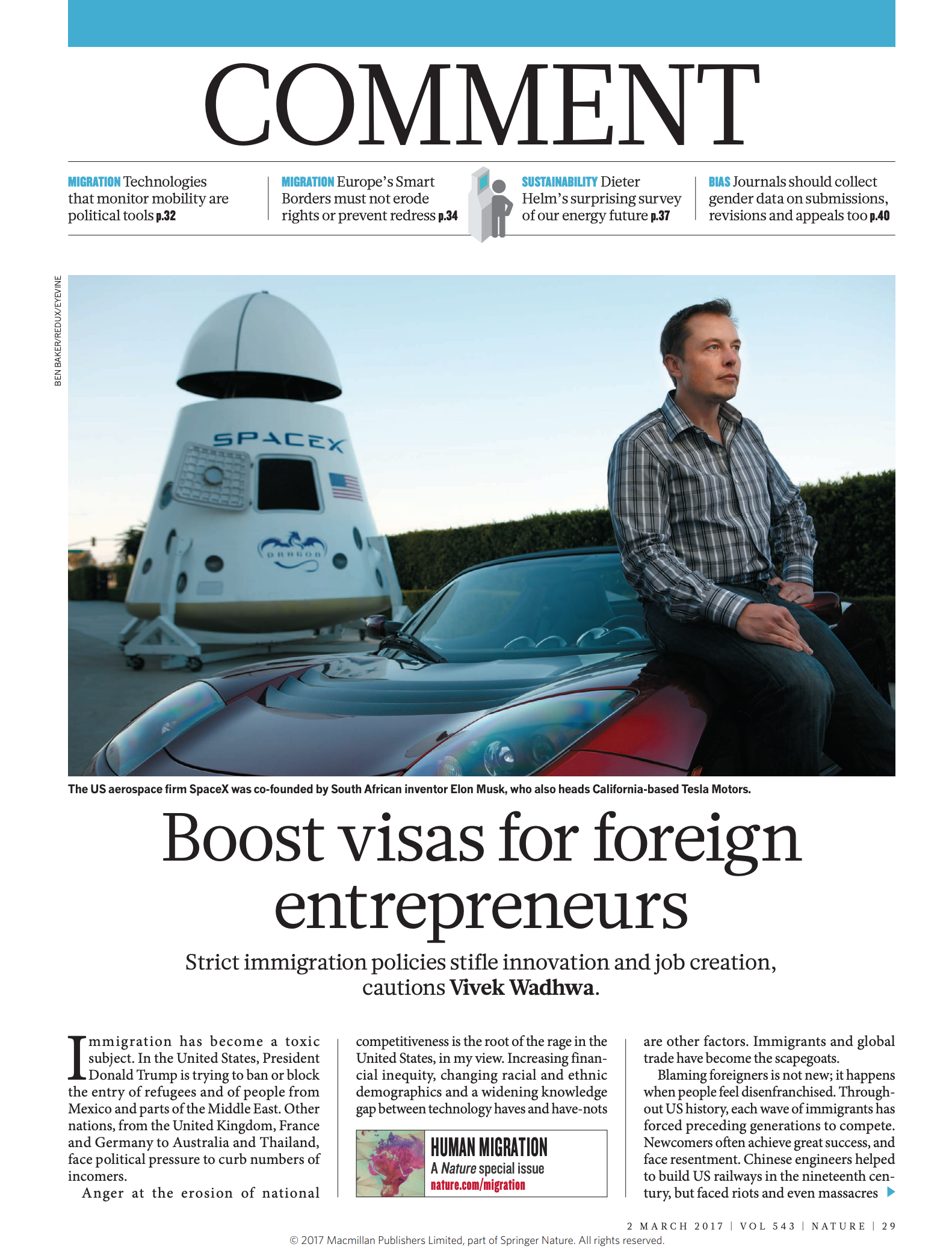
Boost visas for foreign entrepreneurs

The United States needs to expand the number of permanent-resident visas and clear the backlog. These people are already working in the country legally, and have the experience and skills needed. Retaining them will boost the economy. Accelerated granting of permanent residency could be contingent on buying a house, making investments or starting companies that create jobs. Imagine the benefits of 10,000 new technology start-ups.

Unless it changes its immigration outlook, the United States will forgo economic benefits and jobs in a misguided effort to protect both. It will have to watch as the rest of the world leaps ahead. It doesn't have to be this way.

Download

Read More
Losing the world’s best and brightest: America’s new immigrant entrepreneurs, part V

As the economies of the developing world have grown rapidly and Western economies have grown less quickly, anecdotal evidence has begun to suggest that fewer foreign national students wish to stay in the U.S. after graduation. Reports in the popular press, and elsewhere have suggested that many of these students now believe that greater opportunities exist elsewhere in the world. To date, there has been very little empirical research, aside from the NSF surveys, into the post-graduate intentions of foreign nationals, and the key factors driving their decisions to seek to stay in the U.S. or to move abroad. This paper attempts to fill some of this void.

This paper is based on an Facebook survey of 1,224 foreign nationals who are currently studying in institutions of higher learning in the United States or who had graduated by the end of the 2008 academic school year. We found that foreign national students in our sample are planning to leave the U.S. after graduation in numbers that appear to be higher than the historical norm as measured in STEM disciplines. A significant percentage of these students also say they intend to open businesses in the future. This expressed intention is prevalent among Indian and Chinese nationals currently studying in the U.S. This would appear to be a marked contrast to the recent past, when Chinese and Indian degree holders were very likely to stay in the U.S. and continue working or in a research capacity (even more so in the PhD ranks).

Download

Read More
Vivek WadhwaImmigration
An outflow of talent: nativism and the US reverse brain drain

This paper from Harvard International Review, discusses the l cultural and economic tensions that have always existed around the sensitive topics of immigration and immigration policy are again coming to the surface in the United States.

It argues that xenophobic tide could not have come at a more inopportune time. Even before the nativist sentiment emerged, growing numbers of talented immigrants had been abandoning lives in the United States to return to their homelands. They returned due to growing perceptions that brighter economic futures and greater chances for career and professional advancement lay abroad. With America no longer having the huge economic advantage it once had, other factors are coming more into play, such as the inconvenience of current restrictive visa policies and the anxiety associated with living far from friends and family in an unfamiliar culture. The United States is experiencing a brain drain for the first time in its history, yet its leaders do not appear to be aware of this. The ramifications of this brain drain are critical and will be long-lasting.

Download

Read More
A reverse brain drain

This paper from Issues in Science and Technology, which is the journal of the National Academy of Sciences, summarizes our research into immigration and entrepreneurship and argues that the United States – long the beneficiary of talented immigrants – needs to act quickly to keep skilled workers from leaving to pursue expanding opportunities in their home countries.

The danger is that the United States is taking this immigrant contribution for granted at a time when changes in the global economy are providing alternative career opportunities for the most talented people. In the past, the United States was clearly the best place for the most talented scientists and engineers to work, and there was no need to do anything special to attract them. Those days are gone, and the United States must begin paying more attention to what is necessary to attract foreign talent and taking steps to eliminate barriers to immigration.

Download

Read More
Vivek WadhwaImmigration
America’s loss is the world’s gain: America’s new immigrant entrepreneurs, part IV

Since even before the 2008 financial and economic crisis, some observers have noted that a substantial number of highly skilled immigrants have started returning to their home countries, including persons from low-income countries like India and China who have historically tended to stay permanently in the United States.

Who are these returnees? What motivated their decision to leave the United States? How have they fared since returning? This paper attempts to answer these questions through a survey of 1,203 Indian and Chinese immigrants who had worked or received their education in the United States and returned to their home country.

We find that, though restrictive immigration policies caused some returnees to depart the United States, the most significant factors in the decision to return home were career opportunities, family ties, and quality of life.

Download

Read More
Vivek WadhwaImmigration
Skilled immigration and economic growth

This paper from the Applied Research in Economic Development Journal, explores the educational attainment and career trajectories of immigrant entrepreneurs. Our research confirms that advanced education in STEM fields (science, technology, engineering and mathematics) is correlated with high rates of entrepreneurship and innovation among both immigrant and U.S.-born founder populations. To maintain and grow the U.S. entrepreneurial landscape, future policy endeavors may target means of attracting and retaining innovative, highly skilled foreign minds.

Download

Read More
Intellectual property, the immigration backlog, and a reverse brain-drain: America’s new immigrant entrepreneurs, part III

Earlier research revealed a dramatic increase in the contributions of foreign nationals to U.S. intellectual property over an eight-year period. In this paper, we offer a more refined measure of this change and seek to explain this increase with an analysis of the immigrant-visa backlog for skilled workers. The key finding is that there are over one million skilled workers and their families who are in the U.S. awaiting permanent resident visas. This number is significantly larger than the number that can be admitted to the United States. This imbalance creates the potential for a sizeable reverse brain-drain from the United States to the skilled workers’ home countries.

Download

Read More
Vivek WadhwaImmigration
Education, entrepreneurship and immigration: America's new immigrant entrepreneurs, part II

Immigrants who are most likely to start engineering and technology businesses – from India, the UK, China, Taiwan, Japan, and Germany – are better educated than their native-born counterparts. We found 96 percent of all immigrant entrepreneurs involved in engineering and technology have completed a bachelor’s degree, and 74 percent hold master’s or PhD degrees. The great majority (75 percent) of their highest degrees are in science, technology, engineering, and mathematics-related fields.

Immigrant founders were educated in a diverse set of universities in their home countries and across the United States.Those who received their undergraduate degrees in India or China graduated from a diverse assortment of institutions. Even the famed Indian Institutes of Technology educated only 15 percent of Indian company founders. More than half of the foreign-born founders of U.S. technology and engineering businesses initially came to the United States to study. Very few came with the sole purpose of starting a company.

Download

Read More
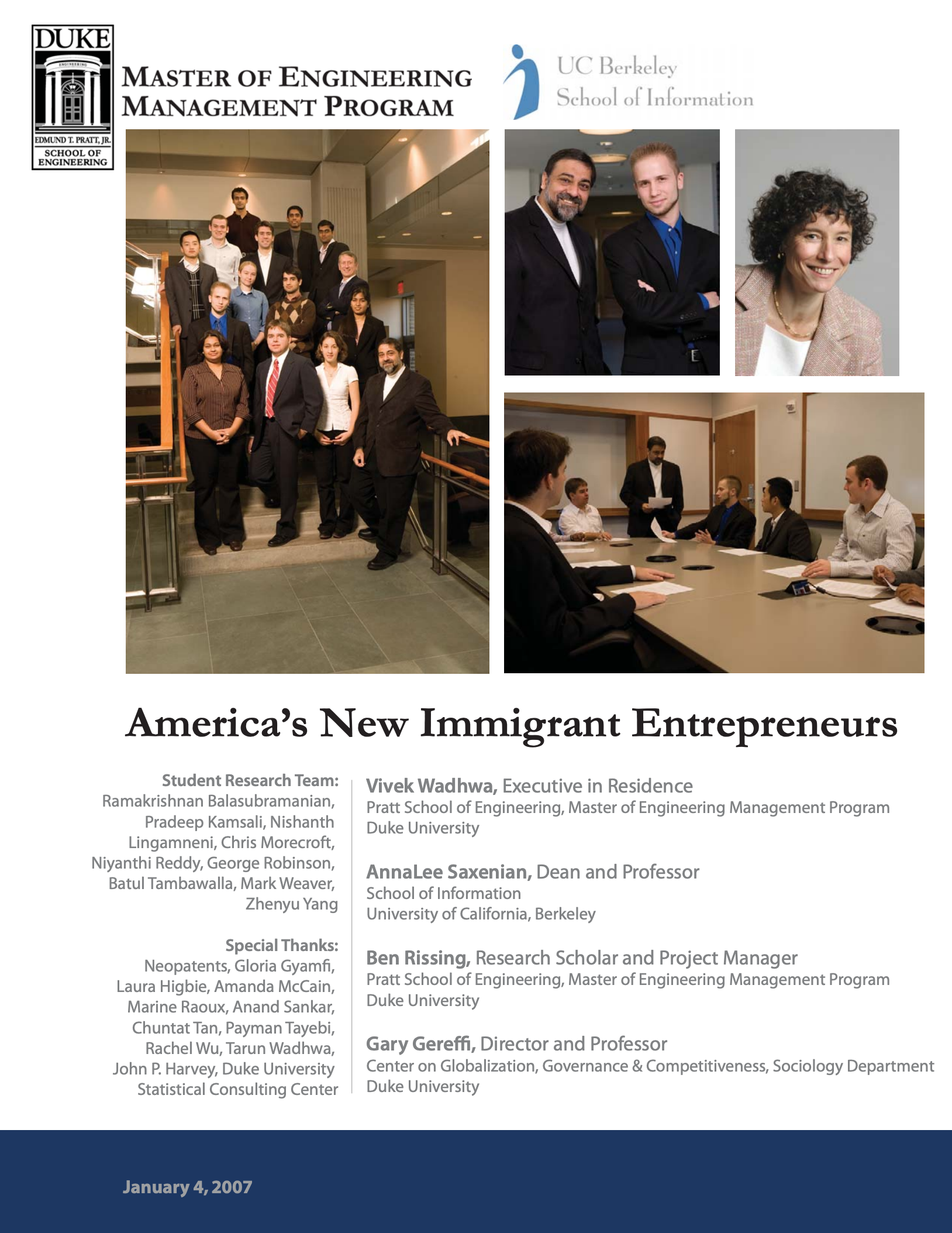
America's new immigrant entrepreneurs: part I

This purpose of this research was to assess the contribution of skilled immigrants in the creation of engineering and technology businesses and intellectual property in the United States. We found there was at least one immigrant key founder in 25.3% of all engineering and technology companies established in the U.S. between 1995 and 2005 inclusive. We estimate that together, this pool of immigrant-founded companies was responsible for generating more than $52 billion in 2005 sales and creating just under 450,000 jobs as of 2005. This research shows that immigrants have become a significant driving force in the creation of new businesses and intellectual property in the U.S. and that their contributions have increased over the past decade.

Download

Read More